
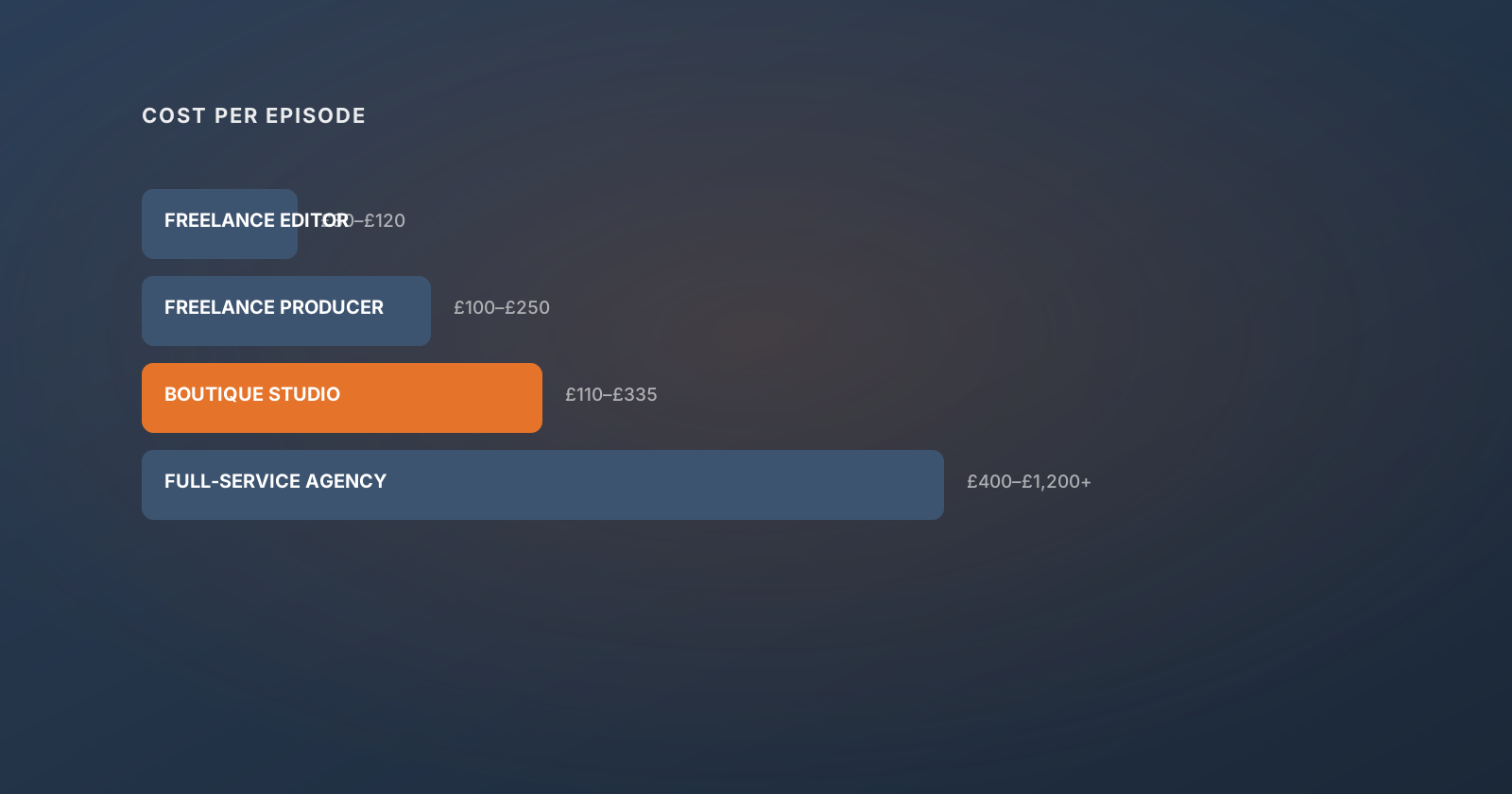
Podcast production costs between roughly £30 and £1,200+ per episode. Most business podcasts land between £110 and £400.
The spread is that wide because "production" describes anything from a single audio edit to a full operation including video, artwork, show notes, clips and publishing. So the honest answer to how much podcast production costs per episode is: it depends entirely on how much of the work you're handing over, and how much of it is video.
Below are the real bands by supplier type, our own published rates, the five things that actually move the number, and what you should expect to be included at each level. If what you need is help comparing two quotes you've already received, how podcast production agency pricing works covers contract structures and hidden costs instead.
Key takeaways
- Typical range: £30–£1,200+ per episode. Most business podcasts sit between £110 and £400.
- Video is the single biggest cost multiplier — it can roughly double an audio-only rate.
- Editing is priced on the work, not the runtime. A messy 40-minute recording costs more than a clean 90-minute one.
- Per-episode rates almost always fall on an ongoing arrangement versus one-off bookings.
- The cheapest quote is rarely the cheapest outcome once your own review time is counted.
How much does podcast production cost per episode, by supplier type
Here's the market, roughly, from cheapest to most expensive:
| Who you're buying from | Typical per-episode range | What that usually buys |
|---|---|---|
| Freelance editor (marketplace) | £30–£120 | The edit only. You brief, review, write notes and publish |
| Experienced freelance producer | £100–£250 | Edit plus show notes or clips. One person, so capacity is the limit |
| Boutique studio (direct) | £110–£335 | Edit through to full production. You deal with the person doing the work |
| Full-service agency | £400–£1,200+ | Production plus strategy, guest booking, account management |
One caveat worth stating plainly: the freelance and full-service agency ranges above are what we consistently see from clients telling us what they've been quoted elsewhere — they're observed ranges, not survey data, and I'm not going to dress them up as research. The middle row is our own published pricing, which you can check on our services page rather than taking on trust.
For UK context specifically, the wider industry range sits at about £200–£850+ per episode depending on scope and supplier.
What the table doesn't show is that these bands overlap heavily in quality. A good freelancer at £150 can comfortably out-produce a mediocre agency at £600, because most of what you're buying at the top end is account management and strategy rather than better editing. Which of those you actually need is the real question.
What we charge, and what's in it
Rather than talk in abstractions, here's our own rate card. It's a reasonable reference point for a UK studio where you work directly with the person editing your show:
| Tier | Per episode | What you get |
|---|---|---|
| Audio editing only | £110 | Full audio edit, Sound cleanup, Pacing, Levels, mastered to −16 LUFS |
| Audio & video production | £165 | Everything in Audio editing only, Full video edit, Captions, Intro and outro, Guest tags / lower thirds |
| Full production | £335 | Everything in Audio & video production, Episode artwork, YouTube thumbnails, Full description and show notes, Intro script, Scheduling and publishing, 3–5 basic clips with captions |
And the common add-ons:
| Add-on | Cost | Notes |
|---|---|---|
| Basic clips | £10 per clip | Straight cut-downs of the best moments — 3–5 are already included in Full production |
| Advanced clips | £40 per clip | Produced clips built to stop the scroll, not just cut from the episode |
| Multi-cam recording | +£95 per episode | Two to three cameras, up to 4K. Adds syncing, angle switching, and colour matching work to every episode. |
So a weekly, fully-produced show with video comes to about £17,420 a year. The same show with audio editing only is closer to £5,720.
If you want the figure for your specific show rather than a band, our podcast editing cost calculator prices it against episode length, format and volume in about thirty seconds.
What decides how much podcast production costs per episode
Quotes vary far more than people expect for what sounds like the same job. These are the reasons.
1. Video, by a distance. This is the biggest single multiplier. Video editing adds a second full edit — one that has to work visually as well as audibly — plus captions, and colour and framing work. A multi-camera setup adds syncing, angle switching and colour matching on top, which is why our multi-cam supplement is £95 per episode. If budget is tight and you're not certain video is earning its cost, audio-only is where the savings are.
2. How much repair the raw audio needs. Editing is priced on the work involved, not the runtime. A clean 90-minute conversation between two people on decent microphones is a quicker job than a messy 40-minute one with a noisy room, mismatched levels and a guest on laptop audio. Suppliers who quote purely on episode length either don't know this or are averaging the risk into everyone's price.
3. Number of speakers. Each additional speaker adds a track to clean, level and cut between. A four-person panel is considerably more work than a two-person interview of the same length, and crosstalk makes every edit decision slower.
4. How tightly you want it cut. "Remove the obvious mistakes" and "make it feel tight and paced" are different jobs with different price tags. A heavy content edit — cutting tangents, restructuring, removing every filler — can take three or four times as long as a light clean-up pass.
5. What comes with it. Show notes, chapters, transcripts, artwork, thumbnails and clips are each real work. A £110 edit and a £335 full production aren't the same service at different margins; they're different amounts of labour. The full breakdown of what post production includes is worth reading if you're trying to work out which line items you actually need.
How much does podcast production cost per episode at each tier
A rough guide to what's reasonable to expect, so you can sense-check a quote.
Under £100 per episode. A basic audio edit. Cuts, some cleanup, levels. You should not expect show notes, video, clips, or much in the way of judgement about pacing. At the very bottom of this band you're often buying someone's first few months of experience, which can be fine for a simple two-person show and is risky for anything else.
£100–£200. A proper audio edit from someone who knows what they're doing, mastered to a sensible loudness target, often with show notes or basic clips. This is where most solo shows and small business podcasts sit, and it's genuinely good value.
£200–£400. Audio and video, or audio plus a full set of assets — notes, chapters, transcript, clips, artwork. This is the band most B2B podcasts land in, because it covers everything between recording and publishing without an agency's overhead on top.
£400–£800. Full production with video, more clips, faster turnaround, and usually some strategic input on format. Reasonable for a company show that matters commercially.
£800+. You're buying strategy, guest booking, account management and often a named producer alongside the production itself. Justifiable when the podcast is a significant channel with a budget to match; hard to justify for a show finding its feet.
One pattern worth knowing: the jump from £200 to £400 usually buys you meaningfully more work. The jump from £600 to £1,000 more often buys you more people involved — account managers, strategists, coordinators. Both can be worth it. They're not the same purchase.
How to bring the cost per episode down
Five things that genuinely reduce the number, in rough order of impact.
Record better. The single most effective cost control there is. Separate tracks per speaker, decent microphones, a room without hard echo, and levels that don't clip. Every problem you avoid at capture is repair work nobody has to bill you for — and unlike the other items on this list, it improves the show as well as the invoice.
Commit to volume. Almost every supplier prices ongoing work below one-off work, because reserved capacity and a settled show spec make each episode faster. A monthly podcast editing retainer with a fixed episode count is normally the cheapest per-episode arrangement available, and it also fixes turnaround, which one-off booking doesn't.
Drop video if it isn't earning. If you're producing video because it felt necessary rather than because clips are performing, this is the biggest single line item you can remove. Check your analytics before you cut it — but check.
Take fewer assets, not lower quality. If budget is tight, buy the edit and write your own show notes. That's a much better trade than paying someone cheaper to do everything worse. You can add assets back once the show proves itself. If you'd rather hand over the whole operation in one go, done-for-you podcast production is the other end of that scale.
Batch your recordings. Doesn't reduce the per-episode fee directly, but it reduces your own time cost substantially and stops the schedule slipping — which is where the real money leaks on a show that stops and restarts.
What rarely works is simply asking for a discount without changing the scope. The work is the work; a supplier who cuts their price 30% without cutting scope is either overcharging you now or will make it back somewhere you'd rather they didn't.
Is it worth paying more?
Sometimes, and it depends on a single question: what is the show for?
If it's a marketing channel for a business selling a considered, high-value product, the arithmetic is usually straightforward. One client won from the podcast typically covers a year of production. At that point arguing about £100 an episode is optimising the wrong variable — the risk isn't overpaying, it's the show quietly stopping because nobody had time to edit it.
If it's a personal project, a passion show, or something you're testing, the calculation is completely different and cheaper is genuinely better. Start at the bottom of the range, see whether you enjoy it and whether anyone listens, and increase spend when the show has earned it. There is no virtue in buying full production for a show that might not exist in six months.
The consistent mistake is buying the most expensive tier at launch, when what a new show most needs is the flexibility to change format cheaply. Formats change a lot in the first ten episodes. Buying artwork and clip packages around a format you're about to abandon is money spent twice.
And the reverse mistake, which is subtler: buying the cheapest possible edit for a show that carries commercial weight. If your buyers hear the podcast before they hear from your sales team, the production standard is doing brand work whether you intended it or not.
If you want a real figure for your show rather than a band, tell us what you're publishing and we'll price it. And if the answer is that you'd be better served by a freelancer at half our rate, we'll say so — it's true more often than you'd expect from a production company's website.
If the show is a company podcast, the sum is different and more specific: what a B2B podcast should cost per episode covers the wider scope those shows need and how to put the number in front of leadership.
Common questions
How much does podcast production cost per episode?
Between roughly £30 and £1,200+ per episode, with most business podcasts landing between £110 and £400. The range is wide because production covers anything from a single audio edit to a full operation with video, artwork, show notes, clips and publishing. Scope and video are what move the number.
How much does it cost to edit a podcast episode?
Audio editing alone typically runs £30–£250 per episode depending on experience and how much repair the recording needs. Our own audio editing rate is £110. Adding video roughly doubles it, because video is a second full edit that has to work visually as well as audibly.
Why do podcast production quotes vary so much?
Five factors: whether video is included, how much repair the raw audio needs, the number of speakers, how tightly you want it cut, and which assets come with it. Two quotes for the same episode length can differ threefold simply because one includes show notes, clips and publishing.
Is podcast production cheaper on a monthly retainer?
Almost always. Ongoing work is priced below one-off bookings because reserved capacity and a settled show spec make each episode faster to produce. A retainer usually fixes turnaround too, which per-episode booking doesn't — you join a queue rather than holding a slot.
How much should a small business budget for a podcast?
For a fortnightly show with a solid audio edit and show notes, budget around £3,000–£6,000 a year in production. Add video and it roughly doubles. Include hosting, recording software and music licensing at £30–£70 a month on top of production fees.
Does episode length change the price?
Less than people expect. Editing is priced on the work involved rather than the runtime, so a clean 90-minute conversation is often a quicker job than a messy 40-minute one with poor audio and four speakers. Suppliers pricing purely per minute are averaging risk across all clients.

Author
Shauna Martin
Head of Content Marketing
Hi, I'm Shauna — I lead content at Selected Frequencies. I spend my days pulling apart what makes a podcast worth listening to and writing it down, so you don't have to learn it all the hard way.