
Show notes are usually written in the last five minutes before an episode goes out. You've done the hard part — booked the guest, had the conversation, sat through the edit — and the description box is the final chore standing between you and hitting publish. So it gets a sentence, a couple of links, and a shrug.
Which is a shame, because your show notes are the only part of your episode a search engine can actually read. The audio is an opaque file. The conversation, however good, is invisible. Everything a crawler or an AI answer engine will ever know about that hour comes from the text you wrap around it — and five rushed minutes is what most shows give it.
Below is a complete worked example, annotated element by element. Hover or tap any part of it to see what that piece is doing and why it's there. If you want the wider strategy this sits inside, our podcast SEO guide covers the whole picture; this piece is the close-up on the single page element that does the most work.
Key takeaways
- Show notes are the only part of an episode a search engine can read — the audio itself is invisible.
- Lead the title with the searchable topic, not the episode number or the guest's name.
- The first two lines survive truncation on every platform, so put the hook and the key phrase there.
- Write the summary answer-first and factual — teasing copy gives AI answer engines nothing to quote.
- A full transcript published as real text is the highest-leverage step most shows skip.
The anatomy of a great set of show notes
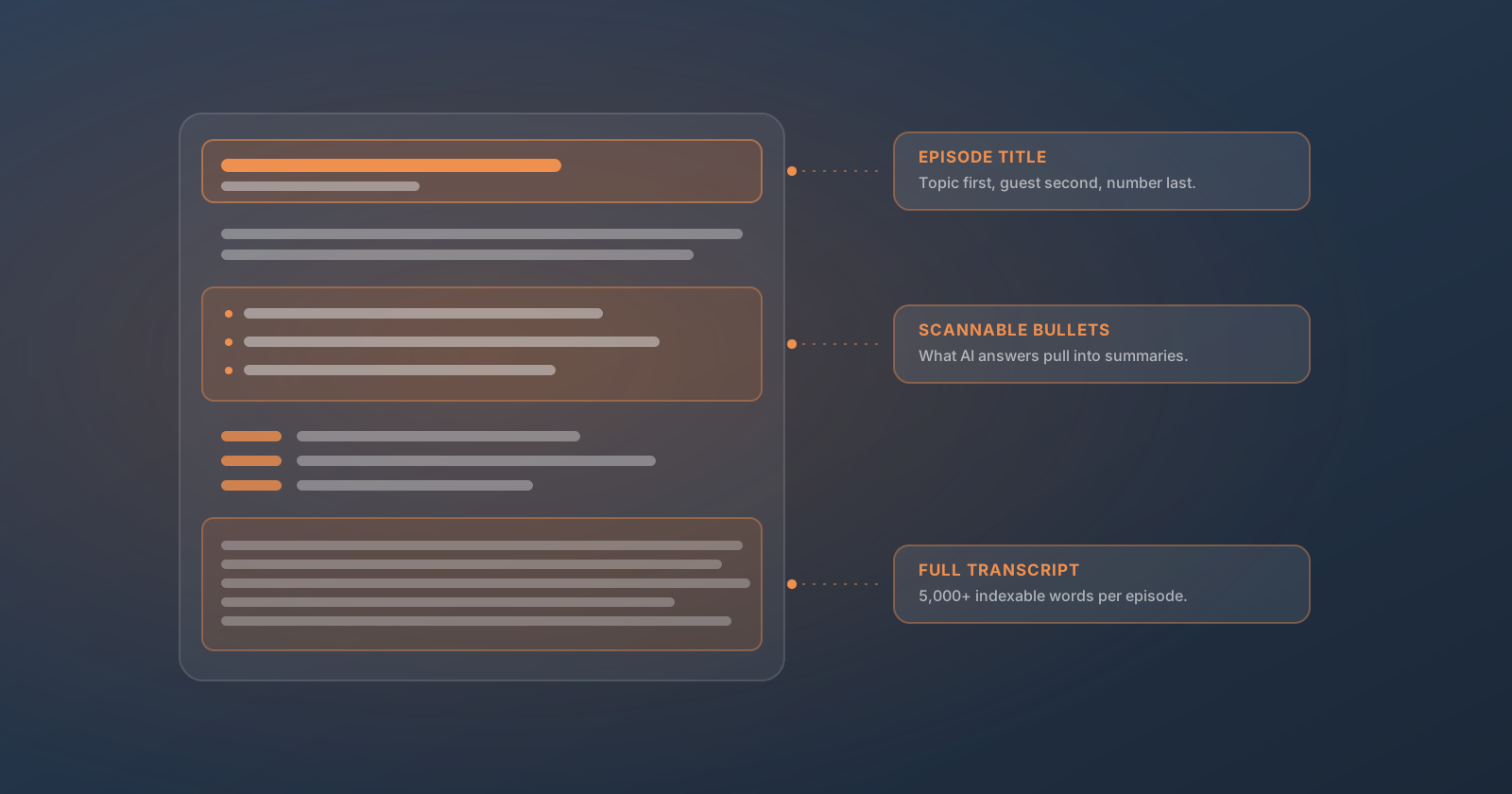
Here's what a complete set looks like for a single episode. Every element below earns its place — and the annotation on each one explains exactly what job it's doing, for the reader and for the machines deciding whether to surface your show.
Hover any section to see why it's there — or tap on mobile.
Episode 84 — show notes
Episode title
How to Actually Value Bitcoin — with Dr Elena Marsh | Ep. 84
The single biggest lever you control. Lead with the searchable topic, then the guest, then the episode number — never the other way round. “Ep. 84 — Chatting with Elena” is invisible to someone searching for the problem you solve. The number still earns its place; it just doesn't go first, because nobody searches for it.
The first two lines (the hook)
Most Bitcoin valuation models are borrowed from equities — and that's exactly why they break. Dr Elena Marsh explains what a monetary asset is actually worth, and how to think about price without pretending it's a stock.
Apple, Spotify, and Google all truncate descriptions after roughly two lines. Everything that matters — your target phrase and the reason to press play — has to survive that cut. Write these two sentences for a human deciding in three seconds, and make sure the phrase you want to rank for appears naturally inside them.
Episode summary
In this episode we get into why traditional discounted cash flow models can't be applied to an asset with no cash flows, what monetary premium actually means, and the three frameworks Elena uses instead. We also cover the most common mistake retail investors make when they try to time the four-year cycle, and why institutional allocators are increasingly treating Bitcoin as a separate asset class rather than a tech proxy.
This is the paragraph that answer engines quote. Write it answer-first and factual, not teasing — “we discuss some fascinating ideas” gives an AI nothing to cite. Name the specific concepts covered. This is also where long-tail search terms live naturally: someone searching “can you use DCF for Bitcoin” should find their exact question reflected here.
“In this episode you'll learn”
- Why discounted cash flow analysis fails for non-yielding assets
- What “monetary premium” means, in plain English
- Three valuation frameworks that work better than DCF
- The most common mistake in four-year cycle timing
- How institutional allocators categorise Bitcoin in 2026
Scannable bullets do two jobs. Humans skim them to decide whether to listen. Search engines and AI answer engines parse them as a structured list of topics — which is exactly the format that gets pulled into “People also ask” boxes and AI summaries. Phrase each one close to how someone would actually search it.
Chapter timestamps
00:00 — Intro
02:14 — Why DCF doesn't apply to Bitcoin
09:41 — Monetary premium explained
18:07 — Three frameworks that work better
27:33 — The four-year cycle timing mistake
36:52 — How institutions actually categorise Bitcoin
44:10 — What Elena would tell a first-time allocator
Chapters improve completion rates — listeners who can navigate stay longer — and YouTube reads them directly to build its chapter bar. Each label is also a miniature keyword-rich heading, so a well-titled chapter can surface for a specific query on its own. Write them as descriptive phrases, never “Part 2” or “More discussion.”
Guest bio and links
Dr Elena Marsh is a monetary economist and former central bank analyst. She writes the Hard Money Letter and lectures on monetary theory.
→ Website · X/Twitter · Her book, The Price of Scarcity
Two reasons this matters. First, linking out to credible sources is a trust signal — pages that cite real people and real work read as more authoritative to both readers and search engines. Second, and more practically: guests share episodes that feature them properly. A proper bio with working links dramatically increases the chance your guest posts it, which is how you earn backlinks without asking.
Resources mentioned
- The Bitcoin Standard — Saifedean Ammous
- BIS Working Paper 1049 on monetary premia
- Elena's 2025 lecture series on non-yielding assets
Genuinely useful to listeners, and it makes your page the most complete resource for that conversation — which is what earns links from other sites. It also gives crawlers additional context about your subject matter. Link out generously; hoarding link equity is a myth that costs you credibility.
Pull quote
“You can't discount cash flows that don't exist. The moment you accept that, you stop asking the wrong question.” — Dr Elena Marsh, 21:04
A ready-made social asset sitting inside your show notes. Timestamped so you or your editor can cut the clip in seconds, and quotable enough that other writers can lift it with attribution — which usually comes with a link. One good quote per episode is enough.
Full transcript
[Full episode transcript, published as readable text on this page]
The highest-leverage step most shows skip. A single episode transcript adds five to ten thousand words of on-topic, indexable text, letting the page rank for dozens of specific questions you'd never target manually. Publish it as real text on the page — not inside a player, not as a PDF, not behind a tab that loads on click. If a crawler can't read it, it may as well not exist. It also makes your show accessible to deaf and hard-of-hearing listeners, which matters on its own terms.
Related episodes
If you found this useful, try Ep. 71 — Monetary Premium and the Gold Comparison, and Ep. 62 — What Institutional Allocation Actually Looks Like.
Subscribe and follow
Listen on Apple Podcasts · Spotify · YouTube — and if this was useful, a rating genuinely helps new listeners find the show.
Every page needs an action. Keep it to one clear ask rather than a wall of platform buttons — and put it at the end, where someone who's read this far is most likely to act.
Structured data (behind the scenes)
<script type="application/ld+json">
{ "@type": "PodcastEpisode", ... }
</script>
Invisible to readers, meaningful to machines. PodcastEpisode schema spells out the episode name, description, show, publication date, and audio file in a format search engines read directly. It won't lift your ranking by itself, but it helps engines understand and present your page — which improves how often people click.
The show, guest, and episode above are illustrative — a fictional example written for this article, not a real client's episode.
The order matters more than the length
Almost every platform truncates. Apple and Spotify cut the description after roughly two lines in most views. Search results clip at around 160 characters. And readers, who are more ruthless than either, decide in about three seconds.
So the sequence of information matters far more than the word count. Front-load everything that has to survive a cut: the topic, the specific promise, the phrase you want to be found for. Whatever sits below the fold of a truncated description is a bonus, not a foundation — write it as though the first two lines are all anyone will ever see, because for a large share of your audience that's exactly true.
The same logic applies inside the episode title. "Ep. 84 — Chatting with Elena" spends its most valuable characters on information nobody searches for. Move the topic to the front and the number to the back, and the same episode becomes findable without losing anything.
What most show notes get wrong
The failures are remarkably consistent across shows, and all five are quick to fix.
The same one-liner, every episode. A recycled boilerplate description tells a search engine that every one of your episodes is about the same thing — which means none of them rank for anything specific. Each episode is a separate page competing for separate searches; give it its own words.
The topic buried behind the episode number. Leading with "Ep. 112" is leading with the one piece of information that has no search volume at all.
Transcripts locked inside a player or a PDF. A transcript only counts if it's real text on the page. Inside an embedded player, behind a tab that loads on click, or attached as a PDF, it's invisible to the crawler — you did the work and got none of the benefit.
No internal links. Most shows never link one episode to another, which leaves both the listener and the search engine at a dead end.
Writing for the people who already listen. In-jokes, first-name-only references, and "as we discussed last week" all assume the reader already knows your show. But show notes are read almost entirely by people who haven't found you yet. Write for the stranger; your regulars will cope.
A repeatable per-episode checklist
The twelve elements above, reduced to something you can run through every week without thinking about it:
- Title — searchable topic first, guest second, episode number last.
- First two lines — the hook and your target phrase, written to survive truncation.
- Summary — answer-first and specific, naming the actual concepts covered.
- "You'll learn" bullets — scannable, phrased the way people search.
- Chapter timestamps — descriptive labels, never "Part 2."
- Guest bio and links — proper credit, working links, so they share it.
- Resources mentioned — link out generously.
- Pull quote — one, timestamped, ready to become a clip.
- Full transcript — real text, on the page.
- Related episodes — at least two internal links.
- One clear call to action — not a wall of platform buttons.
- PodcastEpisode schema — set it up once in your template, then forget it.
That pull quote in step eight is worth more than it looks: it's the seed of a week's worth of social content, which is the subject of our guide to repurposing podcast content.
How long should show notes be?
There's no magic number, and anyone quoting one is guessing. Length isn't a ranking factor in itself — Google doesn't reward 800 words over 400 because it counted them.
What actually helps is coverage. A longer, more thorough set of notes tends to rank better because it naturally matches more specific searches: more of the concepts discussed get named, more of the questions a listener might type get reflected somewhere on the page. Depth wins as a side effect of being genuinely complete, not because the word count crossed a threshold.
So the honest answer is: enough to describe the episode properly — usually a couple of hundred words of summary and bullets — plus the full transcript. That combination is what turns one episode into a page that can answer dozens of different queries. Padding it out with filler to hit an imagined target does nothing except waste your evening.
The hard part is doing it every week
None of the twelve elements above is difficult. Writing them properly for one episode is an enjoyable hour. Writing them properly for episode after episode, on top of booking guests, recording, and editing — that's the part that quietly eats a podcaster's week, and it's usually the first thing to get cut when the schedule tightens. If you've never put a number on that, our editing cost calculator works out what those hours are actually costing you.
For the shows we produce, show notes, chapters, and transcripts are part of the job rather than an afterthought — alongside the edit itself, which is its own craft (our audio quality guide covers that side). If handing it over sounds better than another Sunday night in the description box, see what we do or get a quote.
Common questions
What should podcast show notes include?
At minimum: an episode title that leads with the searchable topic, a hook in the first two lines, an answer-first summary, scannable bullets of what listeners will learn, chapter timestamps, a guest bio with links, resources mentioned, a pull quote, a full transcript, links to related episodes, one clear call to action, and PodcastEpisode structured data.
How long should podcast show notes be?
There's no magic number, and length isn't a ranking factor in itself. Aim for enough to describe the episode properly — usually a couple of hundred words of summary and bullets — plus a full transcript. Depth helps because it matches more specific searches, not because the word count crossed a threshold.
Do show notes help podcast SEO?
Yes — they're the only part of an episode a search engine can read. The audio itself is an opaque file, so everything a crawler or AI answer engine knows about your episode comes from the text around it: the title, description, bullets, chapters, and transcript.
Should I publish a full transcript?
Yes, and as real text on the page rather than inside a player, behind a tab that loads on click, or as a PDF. A single transcript adds five to ten thousand words of on-topic indexable text, letting the page rank for specific questions you'd never target manually. It also makes your show accessible to deaf and hard-of-hearing listeners.

Author
Shauna Martin
Head of Content Marketing
Hi, I'm Shauna — I lead content at Selected Frequencies. I spend my days pulling apart what makes a podcast worth listening to and writing it down, so you don't have to learn it all the hard way.