
Bitcoin has a communication problem, and it always has. It's a genuinely new kind of money built on genuinely difficult ideas — cryptography, decentralisation, monetary history, game theory — wrapped in a decade of scams, volatility, and tribalism that has taught the average person to keep one hand on their wallet. Explaining it in a tweet is hopeless. Explaining it in a headline is worse. The subject punishes the short, shallow formats that dominate the modern internet.
Which is exactly why podcasting has quietly become the medium of record for bitcoin. The best crypto shows aren't chasing virality; they're doing something slower and far more valuable — building trust, one long conversation at a time, with an audience that has every reason to be sceptical. This is a deep look at why that works: why audio is uniquely suited to a low-trust, high-complexity subject, and how a well-made show turns curiosity into conviction. Along the way we'll use two shows we produce — Bitcoin and the Long Game and The Bitcoin Collective — as worked examples of two different routes to the same destination.
Key takeaways
- Bitcoin is too complex and too distrusted for short-form media to explain — long-form audio is where understanding actually forms.
- The human voice, heard over time, is one of the strongest trust signals there is — which is precisely what a distrusted space needs.
- Consistency is the real moat: showing up every week through bull and bear markets is what separates a brand from a bystander.
- A bitcoin podcast compounds — education leads to community, community to conviction, conviction to advocacy, and advocacy back to reach.
- The shows that win educate rather than shill, cut the jargon, and invest in production quality that matches the seriousness of the subject.
Bitcoin's trust problem
Start with the honest truth: most people's first association with crypto isn't sound money or financial sovereignty. It's a scam they read about, a coin that went to zero, an exchange that collapsed, or a relative who won't stop talking about it. The space has spent a decade generating noise, and a lot of that noise has been genuinely bad — fraud, hype cycles, and confident predictions that aged terribly.
That legacy creates a specific problem for anyone trying to communicate about bitcoin seriously. You're not starting from neutral; you're starting from a deficit. The audience arrives pre-loaded with scepticism, and rightly so. Any format that feels like it's selling — a punchy ad, a breathless thread, a price-target video — triggers exactly the defences the space has trained people to raise.
Compounding this is the sheer difficulty of the subject. To really understand why bitcoin might matter, a person has to absorb ideas from monetary history, computer science, economics, and game theory — and hold them together at once. That's not a headline's worth of information. It's not even an article's worth. It's the kind of understanding that forms slowly, through repeated exposure and honest back-and-forth. The formats that win attention today — short, fast, algorithmic — are almost perfectly designed to fail at it.
So the challenge is twofold: rebuild trust in a space that has squandered it, and teach a genuinely hard subject to people who've been burned before. It turns out there's a medium unusually good at both.
Why audio is the antidote
There's a reason humans have trusted voices for as long as we've had them. The voice carries information text can't: hesitation, warmth, conviction, humour, the pause before an honest admission. When you listen to someone talk for an hour, your brain runs a continuous, subconscious authenticity check — and it's very good at catching a fake. Reading a polished paragraph tells you someone can write. Hearing them think out loud, get challenged, and respond in real time tells you whether they actually know what they're talking about.
This is why podcasting is such an unusually good fit for a distrusted subject. You can't fake an hour. A guest who doesn't understand bitcoin will reveal it within minutes of unscripted conversation; a host who's only in it for the grift will grate against a listener's instincts long before the episode ends. The format is self-policing in a way that short clips and written copy simply aren't.
Time is the other half of it. Trust isn't built in a single impressive moment; it's built through repeated, consistent exposure. A listener who spends an hour a week with the same voices, over months, develops something close to a relationship — the parasocial bond that makes podcast audiences so famously loyal and so famously willing to act on what they hear. In a space where the central task is convincing sceptical people that something unfamiliar is worth their attention, that slow accumulation of familiarity and trust is worth more than any amount of reach.
Audio, in other words, does exactly what bitcoin communication needs most: it lets real people demonstrate, over time, that they're worth believing.
Podcasts are how people actually learn bitcoin
Ask almost anyone who's gone deep on bitcoin how they got there, and podcasts come up again and again. Not whitepapers, not textbooks — podcasts, listened to on commutes, at the gym, while doing the dishes. There's a structural reason for that, and it's about how difficult ideas actually take root.
Hard concepts rarely land on first contact. You need to hear an idea explained several different ways, by several different people, before it clicks — and you need the version that happens to match how you think. A long-running podcast delivers exactly this: the same core ideas returned to across dozens of episodes, each guest framing them slightly differently, until one framing finally lands. That repetition-with-variation is how genuine understanding forms, and no single article or video can replicate it.
Podcasts also meet people where their curiosity actually lives — in the dead time of ordinary life. Nobody sits down to study bitcoin for an hour after work. But they'll happily listen to a good conversation about it while walking the dog, and over enough of those walks, a serious education accumulates almost by accident. The format turns passive time into learning time, which is a genuinely rare thing.
And crucially, the best shows teach without lecturing. When a host asks the question you were embarrassed to ask, or admits they didn't understand something either, the format stops feeling like a classroom and starts feeling like a friend explaining it. That lowered guard is when people actually learn — and it's something a jargon-dense article, however accurate, almost never achieves.
The long-form advantage
Bitcoin is a subject of nuance, caveats, and "it depends" — and nuance needs room to breathe. Short formats don't just fail to capture that nuance; they actively distort it. A complex, hedged, carefully-reasoned position gets flattened into a hot take, stripped of the very qualifications that made it responsible. In a space already awash in overconfidence, that flattening is part of the problem.
Long-form audio is where the nuance survives. An hour-long conversation has space for the counter-argument, the historical context, the honest "here's what could go wrong." It can hold two ideas at once — that bitcoin is genuinely important and that plenty of the surrounding industry is nonsense — without collapsing into either cheerleading or dismissal. That intellectual honesty is exactly what earns the trust of a thoughtful, sceptical listener.
This is the terrain Bitcoin and the Long Game is built on. Hosts Peter Lane and George Boyd frame the whole show around a single unifying idea — that sport, money, and life all reward patience — and use it as a lens for exploring bitcoin as a long-term proposition rather than a short-term trade. It's a philosophy that only makes sense at length: you cannot argue for patience in a fifteen-second clip. The format has to embody the message, which is why the show is produced as full audio and video, every week, with no corners cut. A show about playing long games needs production built to last, and a depth of conversation that a shorter format simply couldn't hold.
The lesson generalises. If your subject is genuinely complex — and bitcoin is — the length of the format isn't a cost to minimise. It's the whole point.
Consistency is the real moat
Here's the thing almost no one tells you about podcasting: the single biggest predictor of a show's success isn't the quality of any one episode. It's whether the show keeps showing up. Consistency is the moat, and in bitcoin specifically, it's a moat that most competitors quietly disqualify themselves from.
Crypto runs in violent cycles. In a bull market, everyone has a podcast, a newsletter, a hot opinion. Then the market turns, the attention evaporates, and the vast majority of those shows go quiet — because they were only ever there for the hype. The audience notices. The shows that keep publishing through the bear market, when it's unglamorous and the numbers are down, earn something the fair-weather crowd never can: the trust of people who watched them stay.
The Bitcoin Collective is a case study in exactly this. Jordan Walker has released over 220 episodes since 2021, straight through the full brutal sweep of a crypto cycle — and it holds a 4.8 out of 5 rating on Apple Podcasts. That combination is not an accident. The rating reflects quality; the streak reflects reliability; and together they signal to a new listener that this is a show that will still be here next year. In a space defined by things that vanish, simply not vanishing is a profound competitive advantage.
But consistency at that pace is hard, and this is where most shows break. Hitting a weekly deadline for years, without ever sounding rushed or letting quality slip, takes a production process that runs like clockwork — which is precisely the part that quietly ends most podcasts. The shows that last are the ones that make consistency systematic rather than heroic.
The trust flywheel
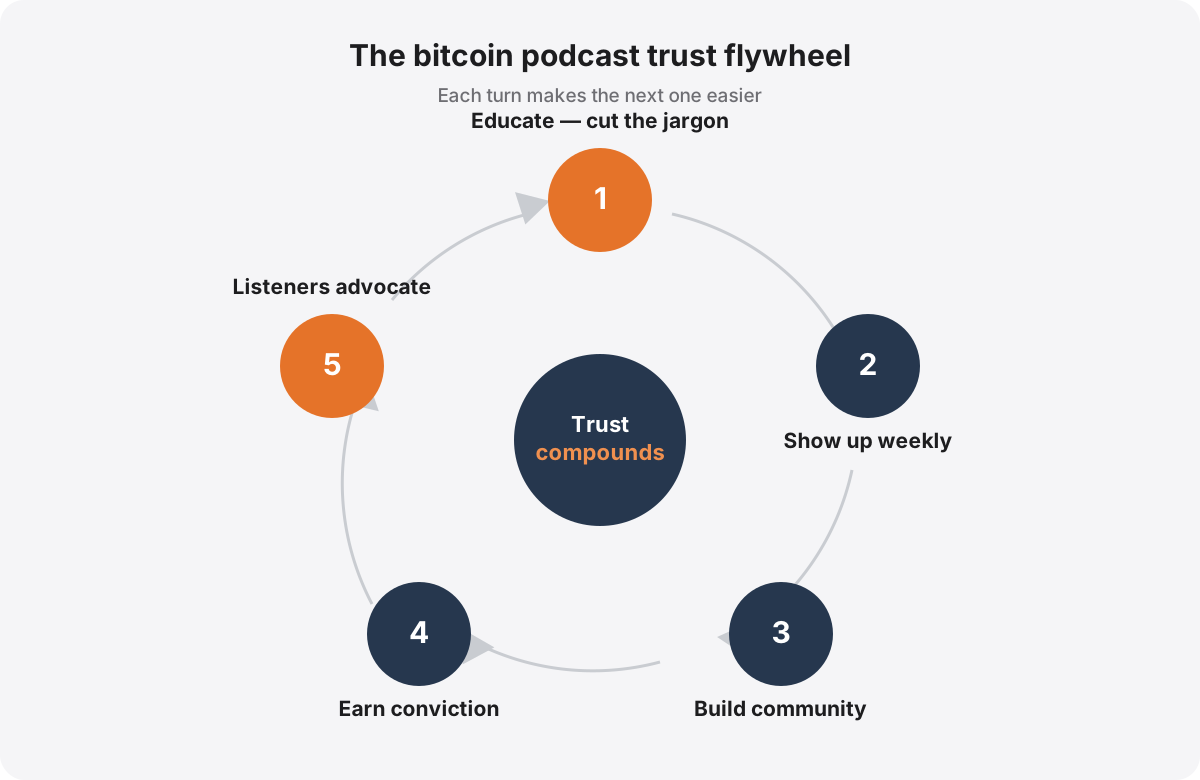
Put the pieces together and a bitcoin podcast starts to look less like a content channel and more like a flywheel — a system where each turn makes the next one easier, and trust compounds at the centre.
It starts with education: you cut the jargon and genuinely help people understand something they found intimidating. That earns you the right to their attention, which you keep by showing up consistently — the reliability that turns a one-off listen into a habit. A habit, sustained, becomes a community: people who don't just listen but identify with the show, show up in the comments, and feel part of something. That sense of belonging deepens into conviction — not the shallow certainty of a price prediction, but the durable confidence that comes from genuinely understanding a subject. And people with conviction advocate: they share episodes, bring in friends, recommend the show unprompted — which feeds new, pre-warmed listeners back into the top of the loop, where the education begins again.
Each lap makes the next one cheaper. The community does some of your marketing. The advocates do some of your guest sourcing. The back catalogue does some of your education for new arrivals. This is why established bitcoin shows are so hard to displace — a competitor isn't up against a single podcast, but against a self-reinforcing system that's been spinning for years.
The catch is that the flywheel only turns if every stage is done well. Weak education never earns the attention. Inconsistency stalls the habit before it forms. And a show that can't sustain its own production quality never gets the flywheel spinning fast enough to matter. Which raises the obvious question: what does "done well" actually look like?
What separates a great bitcoin show from a forgettable one
For all the shows that launch in a bull market, very few become the ones people actually recommend. The difference usually comes down to a handful of things — none of them exotic, all of them consistently underrated.
They cut the jargon. The fastest way to lose a curious newcomer is to talk over their head, and the crypto space is fluent in acronyms and in-group language. The best shows translate relentlessly, explaining terms the first time and never assuming the listener already lives inside the culture. Making the complex feel accessible is the entire job.
They ask the questions the audience is actually thinking. A great host is a proxy for the listener — including the sceptical listener. When the host pushes back, asks "but why does that matter?", or admits confusion, the conversation stays honest and the audience stays with it. Softball interviews where everyone agrees are boring and, worse, they read as promotional.
They book substance over hype. In bitcoin especially, the temptation is to chase the loudest voices. The shows that last book people with genuine expertise and real stories — founders, builders, operators — over the influencers with the biggest follower counts and the thinnest ideas. (We've written separately about how to book guests who actually move the needle.)
They take production seriously. This is the one most shows skimp on, and it shows. A subject as serious as money deserves audio that sounds credible — clean, warm, consistent, easy to listen to. Poor audio doesn't just sound amateur; it subconsciously undermines the authority of everything being said, which in a trust-first space is fatal. (Our guide to broadcast-ready audio covers exactly how to get there.)
None of these is a secret. The advantage comes from doing all of them, consistently, for years.
Two shows, two routes to the same trust
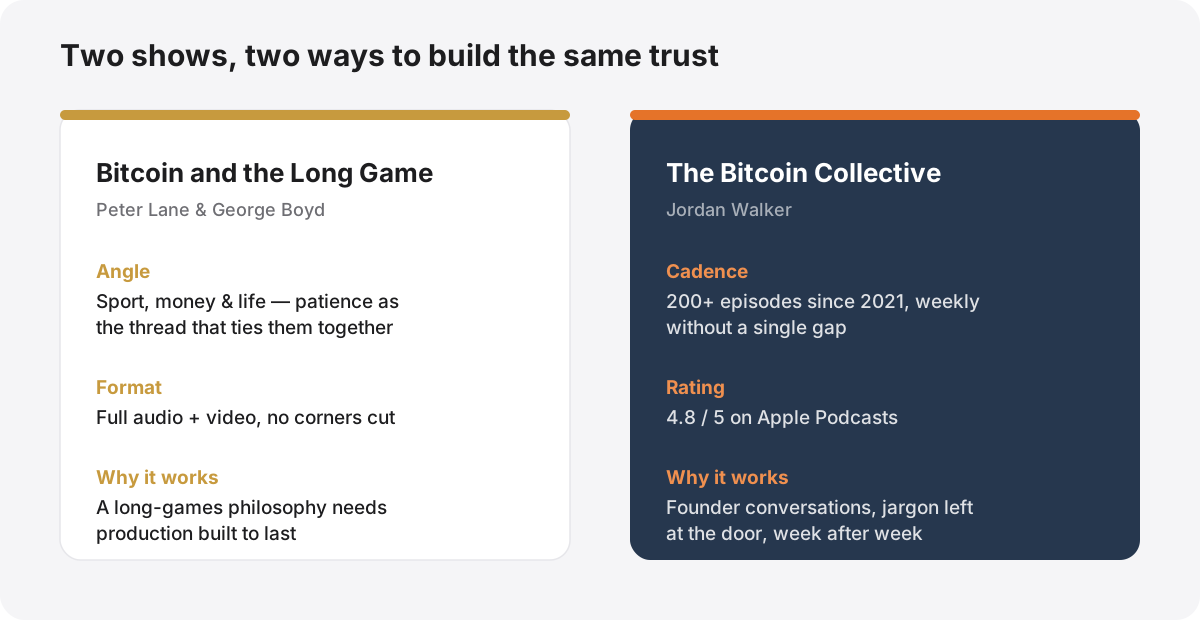
It's worth putting the two shows side by side, because they illustrate something important: there's no single correct way to build trust in bitcoin. There are many, and the best one depends on who you are and who you're for.
Bitcoin and the Long Game builds trust through philosophy and patience. Peter Lane and George Boyd don't treat bitcoin as a standalone topic; they thread it through sport, money, and life, arguing that all three reward the same long-term thinking. That framing does something clever — it meets people through subjects they already care about, and uses them as a bridge to a subject they might not yet. The full audio-and-video production reinforces the message: a show about things that last should itself feel built to last.
The Bitcoin Collective builds trust through relentless consistency and accessibility. Jordan Walker's weekly founder conversations, running unbroken since 2021 with jargon deliberately left at the door, have compounded into 200-plus episodes and a 4.8/5 Apple rating. Where the Long Game wins with depth of philosophy, the Collective wins with breadth and reliability — a huge, welcoming back catalogue that a newcomer can fall into and a regular can rely on.
One leads with a worldview; the other leads with a rhythm. Both arrive at the same place: an audience that trusts the show enough to keep coming back, and to bring others with them. If you're building your own bitcoin show, the useful question isn't "which of these should I copy?" It's "which kind of trust am I best placed to build?" — and then committing to it fully.
Video and clips: meeting new audiences where they are
Audio builds the deep trust, but audio alone has a discovery problem — podcast apps are famously bad at helping new listeners find you. This is where video and short-form clips come in, not as a replacement for the long conversation but as its front door.
A growing share of podcast consumption now happens on YouTube, where the show becomes searchable and browsable in a way it never is inside a podcast app. Publishing a full video version — as Bitcoin and the Long Game does — gives the show a second home on the second-largest search engine in the world, and lets people discover it the way they discover everything else now: by watching.
Short vertical clips do the top-of-funnel work. A sharp two-minute exchange from an episode, captioned and posted to TikTok, Reels, or YouTube Shorts, can reach people who've never opened a podcast app in their life — and give them a low-commitment taste of the show before asking for an hour of their time. In bitcoin, where so much of the audience is being introduced to the subject for the first time, that reach matters enormously. The clip earns the click; the full episode earns the trust.
The key is that clips and video feed the same flywheel rather than competing with it. Every clip is a doorway back to the long-form conversation where the real relationship forms. (We go deep on turning one recording into weeks of this kind of content in our guide to repurposing podcast episodes.)
Owned media in a platform-hostile industry
There's a strategic argument for bitcoin podcasting that rarely gets made, and for anyone building a business in the space it might be the most important one of all: a podcast is owned media in an industry that platforms have repeatedly treated with hostility.
Crypto companies have spent years being deplatformed, shadow-banned, and shut out. Major ad networks have banned or heavily restricted crypto advertising at various points. Social platforms throttle the reach of crypto content, suspend accounts with little warning, and change the rules without notice. Building your entire audience on rented land — a following on a platform that can erase you overnight — is a genuine business risk in this sector, more so than almost any other.
A podcast is different, and the difference is structural. It's distributed through RSS — an open, decentralised protocol that no single company controls. Your feed, your audience relationship, and your back catalogue are yours. Apple or Spotify can't quietly throttle your reach the way a social algorithm can; if one app disappeared tomorrow, your feed would carry on serving every other app unaffected. Pair the show with an email list, and you have a direct line to your audience that no platform can sever. For an industry whose core value is not needing permission, there's something fitting about a distribution channel that works the same way.
This is why a podcast should be seen less as a marketing expense and more as an owned asset that appreciates. Every episode adds to a library you control, deepens relationships no algorithm can revoke, and compounds an audience that belongs to you rather than to a platform that tolerates you. In a space this exposed to platform risk, that ownership isn't a nice-to-have — it's a hedge.
Who should have a bitcoin podcast
Podcasting isn't right for everyone in the space, but it's right for more players than realise it. A few profiles benefit especially clearly.
Founders and builders. If you're building a product, protocol, or company, a podcast is the most efficient way to demonstrate expertise and build an audience that trusts you before you ever ask them for anything. It turns your knowledge into a moat and your credibility into distribution — exactly what a young company needs most.
Funds, brokers, and exchanges. In a business built entirely on trust, a consistent, educational show is a way to earn that trust at scale — humanising the brand, showing the thinking behind it, and staying top-of-mind with clients through every part of the cycle. It's brand-building that also happens to educate the customer.
Educators and independent voices. If teaching bitcoin is your mission, podcasting is simply the best tool ever built for it — the reach of broadcast with the intimacy of a one-to-one conversation. The medium and the mission are almost perfectly matched.
Established institutions entering the space. As bitcoin moves into the mainstream and larger, more traditional players arrive, a podcast is a way to signal seriousness and speak to a sophisticated audience in a credible, non-salesy register — meeting them in the format where they already do their learning.
What all of these share is a need to build trust and demonstrate genuine expertise to a sceptical, high-value audience over time. If that's your situation — and in bitcoin, it usually is — few tools are better suited to the job than a well-made show.
Educate, don't shill
There's a line every serious bitcoin show has to walk, and it's worth naming plainly: the difference between educating and shilling. Cross it, and you forfeit exactly the trust the whole enterprise depends on.
The shows that endure understand that their job is to help people understand, not to tell them what to buy. That means being honest about risk, resisting price predictions, and being clear that a podcast is a conversation and an education — not financial advice. Counter-intuitively, this restraint is what builds credibility. An audience can tell the difference between a host who's genuinely trying to inform them and one who's talking their own book, and they reward the former with a loyalty the latter never earns.
It also means welcoming disagreement. A show that only ever platforms the maximally bullish view isn't educating anyone; it's marketing. The most trusted voices in the space are comfortable sitting with uncertainty, airing the strongest counter-arguments, and letting the listener make up their own mind. That intellectual honesty is not a weakness in a trust-first medium — it's the entire source of the trust.
For anyone building a bitcoin show, this is both an ethical commitment and, not coincidentally, the smart long-term strategy. The grifters get a cycle. The educators get a decade. In a space with bitcoin's history, being visibly, consistently on the side of the listener is the most valuable brand position there is.
How to start (or level up) your bitcoin podcast
If all of this has you thinking about your own show — whether you're a founder, a fund, an educator, or a business that wants a credible voice in the space — here's the practical shape of it.
Get the fundamentals right first. Nail a clear concept and format, sort out the minimum viable gear, and get comfortable recording before you worry about anything fancy. Our interactive nine-step launch checklist walks through the whole path from idea to published episode.
Commit to a cadence you can actually sustain. Consistency beats frequency every time. A reliable episode every two weeks that you keep up for years will out-perform a weekly burst that burns out in three months. Choose the rhythm you can hold through a bear market, then hold it.
Invest in audio quality from day one. In a trust-first space, sound is substance. Broadcast-ready audio signals that you take the subject — and your listener — seriously. Our producer's guide to audio quality covers exactly how.
Make every episode discoverable and repeatable. Publish video, cut clips, write proper show notes and transcripts so search engines can actually find you. (See our guides to podcast SEO and repurposing content, and think in terms of the metrics that actually matter rather than vanity downloads.)
Then protect your own time for the part only you can do — the conversation. The research, editing, show notes, clips, and distribution are enormous, repetitive work, and they're exactly the part that quietly kills shows when a busy founder tries to do it all alone. It's the reason both Bitcoin and the Long Game and The Bitcoin Collective hand their production to us: so the hosts can focus entirely on showing up, week after week, and being worth listening to. If you're building something serious in this space and want it to sound like it, that's a conversation we'd love to have.
References & further reading

Author
Shauna Martin
Head of Content Marketing
Hi, I'm Shauna — I lead content at Selected Frequencies. I spend my days pulling apart what makes a podcast worth listening to and writing it down, so you don't have to learn it all the hard way.