
Short answer: if you want one pair of headphones to start a podcast with and you don't want to think about it again, buy the Audio-Technica ATH-M30x. They're around £50–£70 at the time of writing, they're closed-back, and they're flat enough that decisions you make in them hold up everywhere else.
That's the whole recommendation. There is no catch about needing to upgrade in six months, and there is no version of this article where I tell you the £200 pair is secretly essential.
I produce podcasts for a living, and the question I get more than any other is some form of "what's the cheapest thing that isn't a false economy". For headphones, this is it.
Last updated 8 August 2026. Prices move constantly and vary by retailer — treat every figure here as a range at the time of writing, not a quote.
Key takeaways
- Closed-back, over-ear studio monitoring headphones from Audio-Technica's M-series, widely regarded as the best budget option in the category.
- Flat enough to make real editing decisions in, which is the entire job of a monitoring headphone.
- Closed-back means no bleed into the microphone while recording.
- Compromises are in build materials, long-session comfort, and outright detail — not in the things that would make your show sound wrong.
- A completely different tool from a consumer ANC pair at the same price, and the difference is not about quality.
The short verdict
Good for: recording and monitoring, editing, a first pair, a second pair for a co-host, anyone who wants to stop researching headphones and get on with making a show.
Not for: eight-hour editing days without a break, mastering decisions where fine detail matters, or anyone who wants headphones that are enjoyable to listen to music on.
Buy them if you're starting out, or you're currently editing on consumer headphones and want the single cheapest fix that will genuinely change your output. Don't buy them if you already own a competent flat closed-back pair — the upgrade path from here is real but it is not urgent, and your money does more good spent on the room.
No score is given here. I haven't run these through the same independent-review comparison I did for the Monoprice 110010, and inventing a number to look authoritative is exactly the kind of review this site doesn't publish.
What you get
The M30x sit at the entry point of Audio-Technica's M-series, which is the studio monitoring line that runs up through the M40x and M50x. That lineage matters more than it sounds: these are a cut-down version of a professional product rather than a consumer product with "studio" written on the box.
They're closed-back and over-ear. Closed-back is the non-negotiable part for podcasting, and it's worth being clear about why. Open-back headphones leak sound out of the cups, and anything leaking out of your cups while you're recording goes into your microphone and ends up on the file, where you cannot remove it. Closed-back keeps it in. That single property rules out a large share of otherwise excellent headphones for recording work.
They're wired, with no battery, no Bluetooth and no active noise cancelling. All three of those absences are features for this job rather than corners cut.
The reputation is unusually consistent: the M30x are widely regarded as the best budget option in this category, and they're frequently described as outperforming headphones at twice the price. That's the sort of claim I'd normally treat sceptically, but it has held across a long time and a lot of independent opinion, which is about as close to consensus as audio gear gets.
How it performs for podcasting
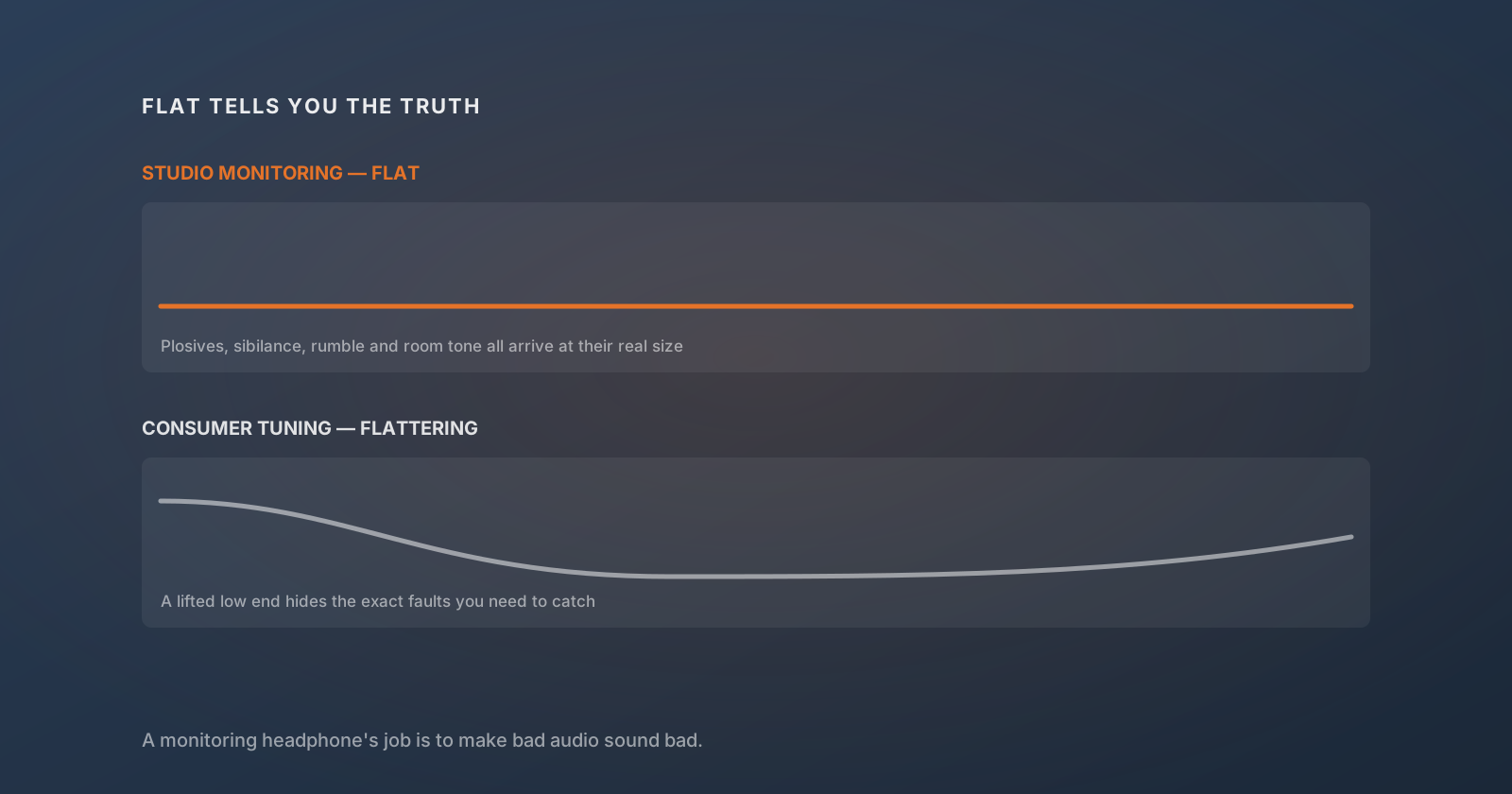
The job of a monitoring headphone is not to sound good. It's to tell you the truth, and a large part of that truth is unflattering.
What flat actually buys you. A flat response means the headphones aren't adding weight to the bass or sparkle to the top. When you hear a problem, the problem is on the recording rather than in the headphones. That sounds obvious until you've spent an hour EQ-ing a voice to sound right in a bass-heavy consumer pair and then discovered the finished episode is thin everywhere else.
What they will reveal. In a flat closed-back pair at this level you should be catching plosives (the thump of a hard "p" hitting the capsule), low-frequency rumble from a desk or a passing lorry, handling noise, and the general character of the room you recorded in. Those are the four things that make an amateur recording sound amateur, and they're all things a bass-boosted consumer pair will partly hide from you.
What they won't do. They will not resolve fine detail the way a more expensive pair does. Very quiet artefacts near the noise floor, and subtle decisions about how much de-essing is too much, are harder to judge here than on something costing three times as much. For the overwhelming majority of spoken-word podcast work, that gap does not affect the finished episode.
Monitoring while recording versus editing. These two jobs pull in slightly different directions, which is worth naming because most guides don't. While recording you want isolation and immediacy: you're listening for problems as they happen so you can stop and fix them in the room, which is always cheaper than fixing them later. While editing you want accuracy and comfort, because you'll be in them for hours. The M30x are strong on the first job and adequate on the second. It's the second where spending more eventually earns its money.
Our podcast audio quality guide covers what to actually listen for at each stage, which matters considerably more than which pair you're wearing.
Who it's for — and who it isn't
Buy these if you're starting out. This is the pair I'd point almost anyone at for a first show. They're enough to record properly and enough to edit properly, and the money you don't spend here is better spent on a dynamic microphone and something soft on the walls.
Buy these as a second pair. If you record in-person guests, having a decent closed-back pair to hand over is worth more than most people expect. A guest doesn't need accuracy, but they do need to hear you clearly without it leaking into their microphone.
Don't buy these if you edit all day. Comfort over very long sessions is the honest weak point of budget monitoring headphones generally, and if editing is your job rather than your hobby, the Sony MDR-7506 is the more sensible landing place. It's the pair studios settled on for a reason.
Don't buy these if you record in the field or in noisy rooms. Isolation and durability become the priority there, and that's a different product entirely — the Sennheiser HD 25 solves that problem in a way nothing else on this list does, including single-ear monitoring for when you need one ear on the mix and one on the room.
Don't buy these expecting to enjoy them. They're not fun. Music through flat monitoring headphones sounds slightly disappointing, which is the correct behaviour for a tool whose job is to make bad audio sound bad.
The contrast worth drawing. The Monoprice 110010 sits in roughly the same price bracket and is a genuinely good product — but it's a completely different tool. It's an active noise cancelling consumer pair: the ANC processes the signal so you aren't hearing exactly what was recorded, and the warm tuning hides the exact problems you need to catch. The M30x is worse at being pleasant and far better at being useful. If you buy one pair for podcasting, buy this one.
How it compares
All four headphones I'd have an opinion about for podcast work, with the pair reviewed here marked.
| Headphones | Roughly | Type | Best for |
|---|---|---|---|
| Audio-Technica ATH-M30x ← this one | ~£50–£70 | Closed-back, over-ear | The best first pair; recording and editing on a budget |
| Sony MDR-7506 | ~£80–£110 | Closed-back, over-ear, foldable | The buy-once workhorse; the broadcast standard |
| Sennheiser HD 25 | ~£120–£150 | Closed-back, on-ear | Field recording, in-person interviews, single-ear monitoring |
| Monoprice 110010 | ~£80 | Closed-back, over-ear, ANC | Listening and travel — not monitoring or editing |
Prices are approximate at the time of writing and vary a lot by retailer. The full roundup, including why noise cancelling is the wrong choice for recording, is in the best headphones for podcasting guide.
If you've read the verdict above and want them: check the current price of the ATH-M30x. That's an affiliate link, and it sits down here rather than at the top on purpose — the recommendation came first and doesn't change either way.
If you're still assembling a setup rather than upgrading one, step 3 of the podcast launch roadmap covers the minimum gear that actually matters.
Where the money actually goes
Having spent a whole article on headphones, the honest framing: headphones are the cheapest meaningful decision in a podcast setup, and they're also the one that quietly determines the quality of every other decision. Get them wrong and you're judging everything through a distortion.
Beyond that, gear is the smallest variable there is. The room matters more than the microphone, the microphone matters more than the interface, and all of them matter less than whether the edit is any good. If the edit is the part eating your week, the editing cost calculator puts a number on what those hours cost you a year.
If you'd rather hand the whole thing over, that's what we do — or start a conversation. Either way, buy the cheap headphones and spend the difference on the room.
Common questions
Are the Audio-Technica ATH-M30x good for podcasting?
Yes, and they're the pair I'd recommend to most people starting out. They're closed-back, so sound doesn't leak out of the cups into your microphone while recording, and they're flat enough that editing decisions made in them hold up on other systems. They sit at the entry point of Audio-Technica's M-series studio monitoring line rather than being a consumer product with studio branding.
What is the difference between the ATH-M30x and the M50x?
They sit at opposite ends of the same M-series studio line, with the M40x in between. The M30x is the entry point and the M50x is the flagship, with the differences generally described in terms of detail, build and comfort rather than a change in purpose. For spoken-word podcast work the M30x is enough; the case for spending more is mostly about comfort across long editing days.
Do I need closed-back headphones for podcasting?
For recording, yes. Open-back headphones leak sound out of the cups, and anything leaking out while you record is picked up by your microphone and printed onto the file, where it cannot be removed. Closed-back keeps the sound in. If you only ever edit and never record with a live microphone in the room, open-back becomes viable, but closed-back is the safer single purchase.
Should I use noise cancelling headphones to record?
No. Active noise cancelling generates an inverse waveform to cancel outside sound, so what reaches your ear is the recording plus a layer of real-time processing rather than the recording itself. It can also introduce small amounts of latency, which is genuinely disorienting when monitoring your own voice. Use passive closed-back headphones with no active processing.
Are the ATH-M30x comfortable for long editing sessions?
Comfort over very long sessions is the honest weak point of budget monitoring headphones as a category, and it is the main argument for spending more rather than any deficiency in how they sound. For an hour or two they are fine. If editing is your job rather than your hobby, that is the reason to look at the Sony MDR-7506 instead.

Author
James Pearce
Founder & Podcast Producer
I'm James — I founded Selected Frequencies and produce the shows we work on. Eight years in audio, from BBC Radio 1 mixes to thousands of podcast episodes, and I still edit every show myself.