
Short answer: the Sennheiser HD 25 is not the obvious first pair for a solo podcaster editing at a desk, and it is the right answer for anyone recording in the field, running in-person interviews, or working somewhere noisy. Around £120–£150 at the time of writing.
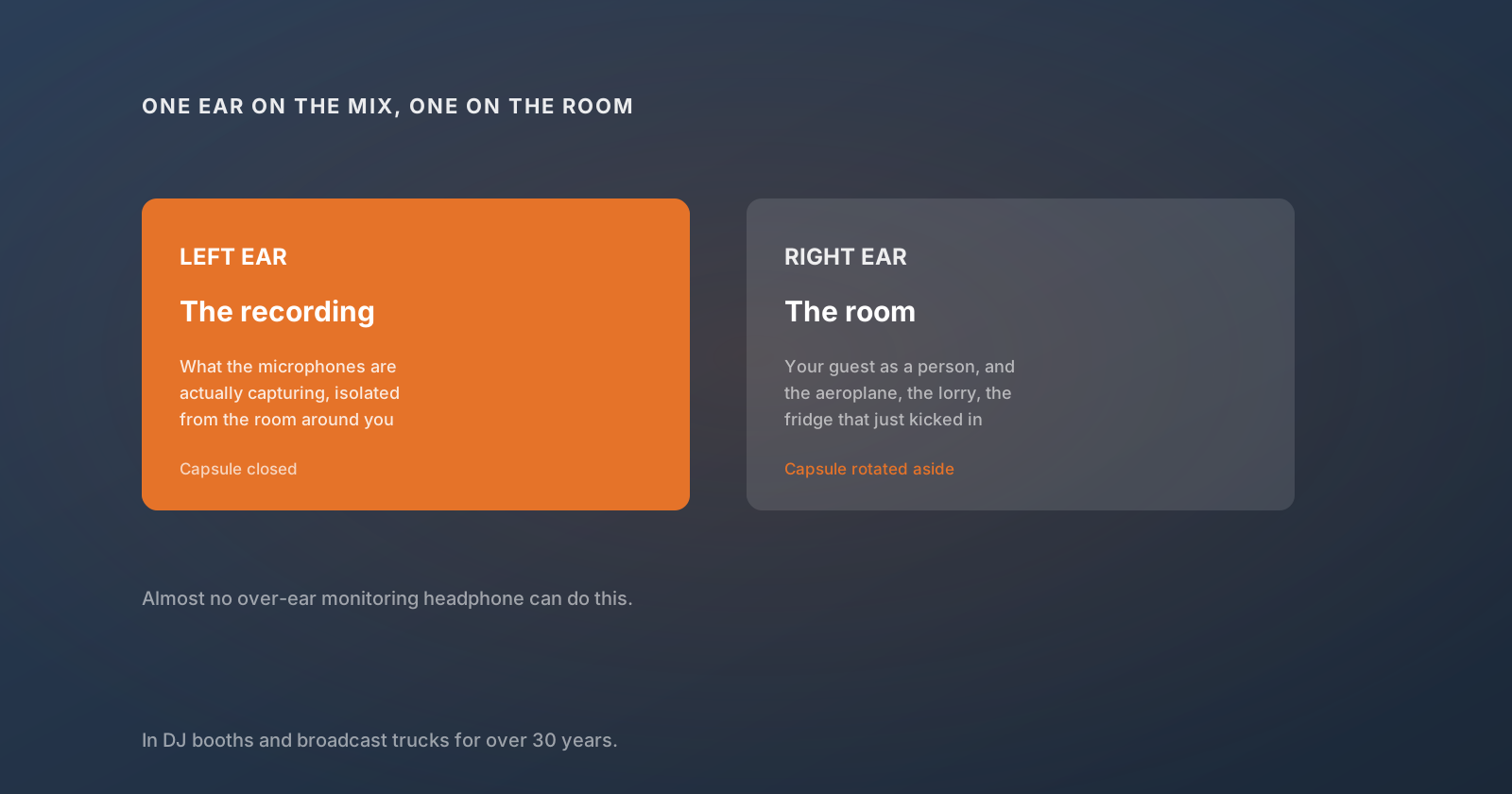
It has been a fixture in DJ booths and broadcast trucks for over thirty years, and it solves a problem most podcast gear guides never name: how to listen to your recording and the room at the same time.
That one capability is why this pair belongs in a podcasting conversation at all, and why almost every "best podcast headphones" list gets it wrong by leaving it out or by ranking it as a slightly odd alternative to an over-ear monitor. It isn't an alternative. It's a different job.
Last updated 8 August 2026. Prices move and vary by retailer — treat figures here as ranges at the time of writing.
Key takeaways
- The rotating capsule allows single-ear monitoring: one ear on the mix, one on the room.
- On-ear rather than over-ear, very lightweight, with a reinforced headband and field-replaceable parts.
- Excellent isolation and high SPL handling, which is what makes it work in genuinely noisy environments.
- Strong transient reproduction makes attacks and stops easy to hear, which matters for placing edits precisely.
- Not the most comfortable pair here for a full day of desk editing — the on-ear clamp is the honest trade-off.
The short verdict
Good for: field and location recording, in-person interviews, live sessions, noisy environments, and any situation where you need one ear on the recording and one on the room.
Not for: a solo podcaster editing at a quiet desk all day. The on-ear design clamps, and comfort across a long session is where it gives ground to every over-ear pair on this list.
Buy them if you record outside a controlled room with any regularity, or you run sessions where you also need to hear the people in front of you. Don't buy them if your podcast is you, a microphone, and a spare room — you'd be paying a premium for capabilities you'll never use, and the ATH-M30x or MDR-7506 would serve you better for less.
No score is given, for the same reason as the other reviews in this cluster: the page displays no rating, so none is claimed.
What you get
The HD 25 looks plain and slightly cheap for the money, which is the first thing most people notice and the first thing to get past. Almost every design decision is about surviving work rather than looking like a premium product.
On-ear, closed-back. It sits on the ear rather than around it. This is the central trade-off of the whole design and I'll come back to it, because it buys the low weight and costs you long-session comfort.
A rotating capsule. One earcup swivels out of the way so you can wear a single ear. This is the defining feature and the entire reason the article exists.
A reinforced headband and field-replaceable parts. Effectively every component that wears — pads, cable, capsules, headband — can be replaced without a workshop. This is why thirty-year-old pairs are still in service, and it changes the purchase from a product into a platform. When something breaks in a field kit, "replace the part on site" and "the job stops" are very different outcomes.
Very lightweight. A direct consequence of the on-ear design. Over a long day on location, weight is fatigue, and this is where the HD 25 wins back some of what the clamp costs it.
High SPL handling and excellent isolation. These two together are what make it usable next to a loud source, whether that's a PA, a band, or simply a room full of people.
Variants. It's also sold as the HD 25 Light and HD 25 Plus. They differ in what's included and in construction. I'd check exactly which one a listing is offering before buying, because the naming does not make the differences obvious.
How it performs for podcasting
Three capabilities matter here, and only one of them shows up in ordinary headphone reviews.
Single-ear monitoring, which is the whole point
The rotating capsule means you can push one cup aside and work with one ear on the recording and one ear on the room. If you have never needed this, it sounds like a gimmick. If you have, it's the reason you own the headphones.
Where it matters for podcasting:
- In-person interviews. You need to hear what the microphones are actually capturing, and you need to hear your guest as a person in front of you. Covering both ears puts a wall between you and the conversation, and conversations are the product. Uncovering both means you're not monitoring at all and you'll discover the problem in the edit.
- Live sessions and events. One ear on the desk feed, one on the room, which is exactly how live sound and broadcast have always worked.
- Location recording. One ear on the recorder, one listening for the aeroplane, the reversing lorry, or the fridge that just kicked in — the things that ruin a take and that you can only avoid by hearing them coming.
This is genuinely rare. Almost no consumer-facing podcast headphone guide mentions it, and no over-ear monitoring headphone does it well: taking one cup off an over-ear pair leaves it hanging awkwardly and usually unseats the other side.
Isolation that works in real environments
Passive isolation is not noise cancelling and the distinction matters. Isolation is physical — the seal blocks sound before it reaches your ear, with nothing processing your audio. Noise cancelling is electronic, and it processes the signal, which is why it is the wrong tool for monitoring (the Monoprice 110010 review covers that argument in full).
The HD 25 gets you quiet without touching the signal. In a noisy space that's the difference between being able to judge a recording and guessing at it.
Transient clarity, for knowing where the edit lands
Strong transient reproduction means attacks and stops are easy to hear: the precise moment a word begins, the exact point a breath ends. For editing speech, that is more useful than it sounds. Most edit decisions in a conversation are about finding the true start and end of a phrase, and headphones that render those edges sharply let you place a cut by ear rather than by squinting at a waveform.
Who it's for — and who it isn't
I want to be more restrictive here than a review normally is, because the specificity is the recommendation.
Buy these if you record in the field. Lightweight, tough, isolating, field-serviceable. This is what the design is for and nothing else on this list competes.
Buy these if you interview people in person. The single-ear capability changes how the session feels for both of you, and monitoring properly during an in-person interview is otherwise a genuinely awkward compromise.
Buy these if you work somewhere noisy. Isolation without processing is the only honest way to monitor in a loud room.
Don't buy these for desk editing. This is the honest downside and it should be first in your mind if you're a solo podcaster. On-ear means the pads press on your ear rather than surrounding it, and the clamp needed for isolation is the same clamp that becomes uncomfortable over hours. For a full editing day, the MDR-7506 is more comfortable and cheaper, and there's no case for suffering to own the more specialised tool.
Don't buy these as a first pair. If you're starting out, the ATH-M30x at roughly half the price will not hold you back, and it's a better fit for the way most new podcasts are actually made — one person, one room, one desk.
Don't buy these expecting them to look like the money. They're plain, and the price reflects durability and a specific capability rather than materials or finish. If that bothers you, it's a real consideration and I'd rather say so.
How it compares
| Headphones | Roughly | Type | Best for |
|---|---|---|---|
| Audio-Technica ATH-M30x | ~£50–£70 | Closed-back, over-ear | The best first pair; recording and editing on a budget |
| Sony MDR-7506 | ~£80–£110 | Closed-back, over-ear, foldable | The buy-once workhorse; the broadcast standard |
| Sennheiser HD 25 ← this one | ~£120–£150 | Closed-back, on-ear | Field recording, in-person interviews, single-ear monitoring |
| Monoprice 110010 | ~£80 | Closed-back, over-ear, ANC | Listening and travel — not monitoring or editing |
Prices are approximate at the time of writing and vary by retailer and variant. The full roundup is in the best headphones for podcasting guide.
If the field-work case above describes your show: check the current price of the HD 25. Affiliate link, deliberately placed below the verdict and the caveats.
For what to listen for once you're wearing any of these, the podcast audio quality guide is the companion piece. If you're still assembling a first setup, step 3 of the podcast launch roadmap covers the minimum that actually matters — and for most people starting out, that minimum does not include these.
The honest framing
Most gear articles are written to make you buy the thing. This one is genuinely trying to narrow the audience, because the HD 25 is a specialist tool and specialist tools bought for the wrong reason are just expensive compromises.
If you record in a spare room and edit at a desk, buy cheaper headphones and put the difference into something soft on the walls. The room is a bigger variable than any pair of headphones on this list, and it always will be.
If you work outside that room — location interviews, live sessions, events, anywhere with people and noise in it — then this solves problems the others can't, and the price stops looking like a premium.
If the production work itself is the constraint rather than the kit, the editing cost calculator puts a yearly number on the hours. And if you'd rather hand the recording and the edit over entirely, that's what we do — start a conversation.
Common questions
Is the Sennheiser HD 25 good for podcasting?
It depends entirely on how you record. For field recording, in-person interviews, live sessions or noisy environments it is the strongest option here, largely because the rotating capsule lets you monitor with one ear while hearing the room with the other. For a solo podcaster editing at a quiet desk it is an expensive way to buy capabilities you won't use, and the on-ear design is less comfortable over long sessions.
What is single-ear monitoring and why does it matter?
It means listening to your recording through one ear while leaving the other ear open to the room. The HD 25's capsule rotates out of the way to allow it. It matters when you need to judge what the microphones are capturing and stay present in the room at the same time, which is the normal situation during an in-person interview, a live session, or any recording on location.
Is the HD 25 on-ear design uncomfortable?
It is the honest trade-off. On-ear means the pads press against the ear rather than surrounding it, and the clamping force that produces the isolation is the same force that becomes tiring over several hours. It is very light, which helps on a long day in the field, but for a full day of desk editing an over-ear pair like the Sony MDR-7506 is more comfortable.
What is the difference between the HD 25, HD 25 Light and HD 25 Plus?
They are variants of the same design that differ in construction and in what is included in the box. The naming does not make the differences obvious, so it is worth checking exactly which version a listing is offering before buying, particularly when comparing prices across retailers.
Do I need closed-back headphones for podcasting?
For recording, yes. Open-back headphones leak sound out of the cups, and anything leaking while a microphone is live is captured onto the file where it cannot be removed. The HD 25 is closed-back and isolates well, which is a large part of why it works in noisy environments.
Should I use noise cancelling headphones to record?
No. Noise cancelling is electronic: it generates an inverse waveform, so you hear your recording plus a layer of real-time processing rather than the recording itself, and it can add latency that makes monitoring your own voice disorienting. Passive isolation, which is what the HD 25 provides, blocks sound physically without touching the signal. That is the version you want when monitoring.

Author
James Pearce
Founder & Podcast Producer
I'm James — I founded Selected Frequencies and produce the shows we work on. Eight years in audio, from BBC Radio 1 mixes to thousands of podcast episodes, and I still edit every show myself.